
Own the model
Run it locally
Built for one job
Custom small AI models for one-job workflows
Turn your repetitive AI task into a tiny model you own.
Stop paying frontier-model prices for narrow work. Tiny Model Generator creates task-specific AI models that run locally, privately, and affordably on normal hardware.
~1GB class models
Cheap CPU capable
Dataset generated
Model fine-tuned
GGUF/Ollama ready
Eval report included
Right-sized AI
Big models are incredible. They are also overkill for small jobs.
A giant hosted model makes sense when you need broad reasoning. But many business workflows are narrow, repeated, and measurable. Those workflows do not need an endless API bill. They need a compact model trained to do one thing reliably.
Generic AI workflow
- Large model for every small request
- Permanent per-token API costs
- Private data leaves your machine
- Prompt drift and inconsistent formats
- Vendor lock-in by default
Tiny Model Generator workflow
- Small model specialized for your exact task
- Local inference with no metered API dependency
- Private, offline-capable deployment
- Tested output format and edge cases
- Portable artifact you can keep
If you are searching for this
"I need AI that runs without a GPU."
You may not be looking for "fine-tuning" or "GGUF" yet. You may just know that cloud AI is getting expensive, GPUs are costly, and you want an AI model that can run on a normal computer, cheap CPU server, laptop, or private machine.
We build small task models designed for CPU-friendly local inference when the workflow is narrow.
Not every AI feature needs a GPU endpoint. Repetitive jobs can often be handled by a tiny model.
No. A GPU is optional. It can make tiny models run faster and serve more users, but it is not required for the CPU-friendly models we specialize in.
Keep private data on your own laptop, server, kiosk, or internal machine instead of sending every request to an API.
Move stable, high-volume AI tasks away from permanent per-token billing and onto hardware you control.
What tiny models unlock
Specialized AI on the cheapest hardware available.
The magic is not making a small model know everything. The magic is making it know exactly what your workflow needs, then running that intelligence wherever the work happens.
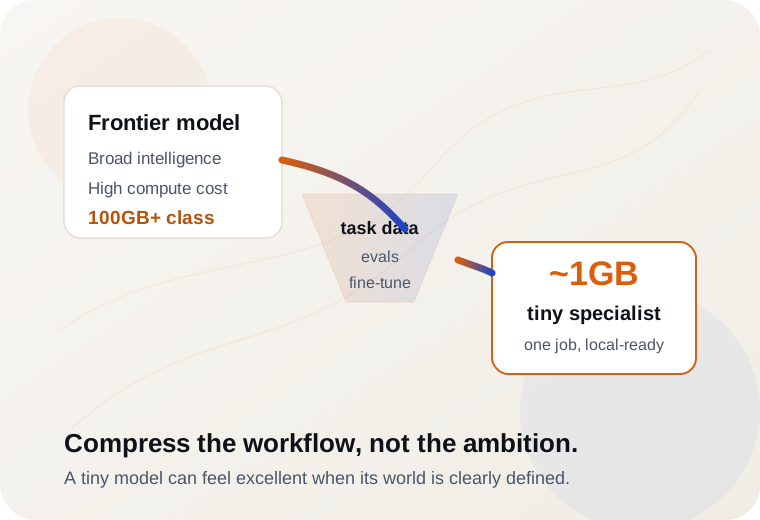
Model compression as a product
Compress one workflow into a tiny specialist.
A frontier model can help create the dataset, but the final product can be a compact model trained for one job: extract, route, classify, rewrite, or generate a strict schema.
- ~1GB class deployment targets when the task allows it
- Short prompts, predictable output, less wandering
- Eval-tested behavior before delivery
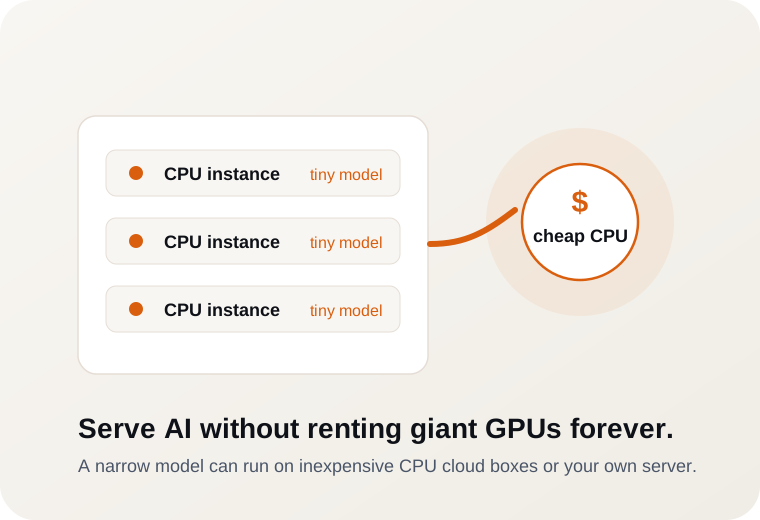
Cloud bills get smaller
Run useful AI on cheap CPU compute.
If a model only needs to do one narrow job, it should not require an expensive GPU endpoint forever. Tiny specialists can make private servers, budget VPS boxes, and low-cost CPU fleets viable again.
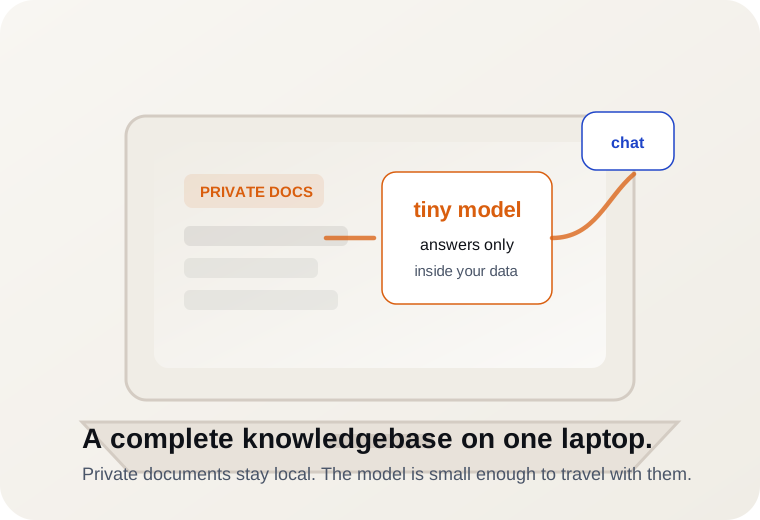
Private local knowledge
A complete knowledgebase on one laptop.
Package internal rules, documents, workflows, and response formats into a local assistant that can work offline without sending private data to a remote API.
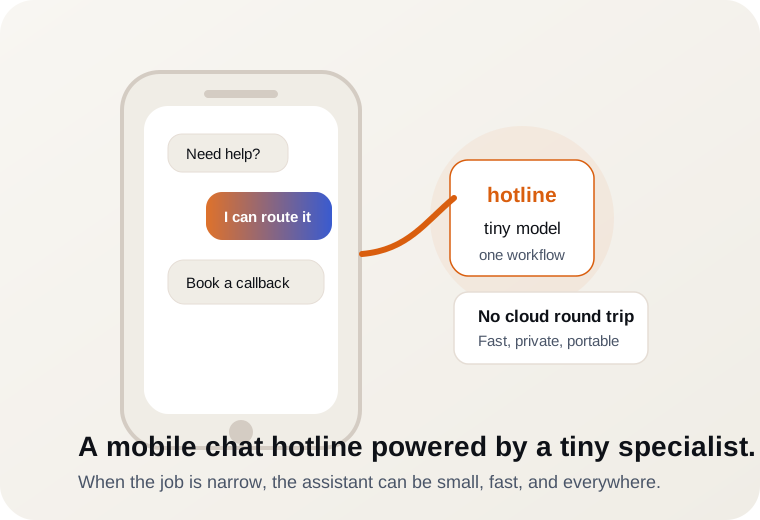
Tiny enough to go everywhere
A mobile chat hotline for one business process.
Imagine a small model that handles a narrow hotline: qualify the request, ask the missing question, route the case, and produce the next action from a phone or edge device.
The sweet spot
Built for focused tasks, not vague magic.
Tiny models win when the job is clear. If the input and output can be described, tested, and repeated, we can often compress that workflow into a small local model.
Great fit
Classify, extract, route, rewrite, validate, summarize, or output JSON for a narrow workflow.
Possible fit
Domain assistants with constrained actions, known data, and a measurable success condition.
Bad fit
"Make a model that knows everything" or broad chatbot behavior with no defined output target.
How it works
From task description to local-ready model.
Describe the task
Tell us what the model receives, what it should produce, and what mistakes matter most.
We design the behavior
We define the task spec, output schema, examples, edge cases, and refusal rules.
We create the dataset
We generate and validate training examples so the labels match the behavior you need.
We fine-tune and test
A compact open model is trained, evaluated, and checked against held-out cases.
You receive the model
Delivery includes a local-ready model artifact, usage notes, sample prompts, and an eval report.
What you get
A tiny model package ready for real deployment.
Local model artifact
Delivered in practical formats for local inference, including GGUF and Ollama-ready packaging when appropriate.
Task specification
A clear definition of what the model was trained to do, what it should not do, and how to call it.
Evaluation report
Representative pass/fail cases, sample outputs, known limitations, and recommended deployment settings.
Deployment guidance
Instructions for running the model locally in tools such as Ollama, llama.cpp, or your own application stack.
Use cases
Small models are perfect when the job is specific.
These are the places where a tiny specialist can replace an expensive always-on general model: clear input, clear output, measurable behavior.
Support ticket routing
Classify requests, assign teams, detect urgency, and output structured routing data.
messy inbox -> clean actionCheap CPU chat
Answer inside a narrow support or knowledgebase domain without a dedicated GPU.
small server, real utilityField extraction
Convert messy messages, emails, and short documents into clean JSON.
Lead qualification
Score inbound leads using your criteria, not a generic sales template.
Private laptop copilots
Keep internal documents, workflow rules, and model inference on the same local machine.
private knowledgebase, no cloud round tripVoice command parsing
Turn spoken intent into safe, constrained commands for local systems.
Schema output models
Generate consistent, valid output for apps that cannot tolerate format drift.
Mobile hotline models
Power simple intake, triage, and routing flows on phones or edge devices.
one process, always availableWorkflow selection
Pick the correct internal process, template, or automation from user input.
Private rewriting
Rewrite text in a brand voice or compliance-safe style without sending data away.
API cost replacement
Move stable, repetitive AI calls from expensive hosted models to a tiny model you own.
pay once to build, then run where it makes senseSee the difference live
Same question. Completely different result.
A general model has no idea who you are or what your business does. A tiny trained specialist answers with precision — locally, privately, at zero ongoing inference cost.
General AI
Frontier model
No domain training
~100 GB+
~$0.05 / req
Waiting for query…
Tiny Specialist
Your trained model
Trained on your data, runs locally
~689 MB
$0.00 / req
Waiting for query…
General AI
Model size100 GB+
Runs onCloud GPU (rented)
PrivacyData leaves your server
Cost per request$0.03–$0.08
Domain knowledgeNone
Tiny Specialist
Model size~689 MB
Runs onYour CPU, your machine
PrivacyNever leaves your machine
Cost per request$0.00
Domain knowledgeDeep & precise
Custom fine-tuned AI models without the ML headache
You bring the workflow. We handle the model pipeline.
Fine-tuning a small language model usually means selecting a base model, creating training data, cleaning labels, choosing hyperparameters, testing behavior, quantizing weights, writing deployment files, and debugging local inference. Tiny Model Generator packages that process into a practical service for founders, builders, small teams, and local-first products.
The result is a custom small AI model designed for a specific task, not a broad chatbot. It can lower inference cost, improve privacy, and make AI features viable on ordinary hardware.
If you are looking for an AI model that runs on CPU, an AI model that works without a GPU, a local AI assistant for private data, or a small model that can run on cheap cloud compute, this is the category we are building for.
Plain-English answers
Questions people ask before they know the jargon.
You do not need to know model architecture, quantization, or GPU sizing to start. The question is simpler: do you have a repeated AI task that should run cheaper, locally, or privately?
Can AI run without a GPU?
Yes, when the model is small enough and the task is focused. A tiny model can often run on CPU, a laptop, or a cheap server for narrow workflows.
Can it chat perfectly?
It should not try to chat about everything. It can feel excellent inside one clear job, like support routing, local knowledgebase answers, structured output, or intake triage.
Do I need to understand fine-tuning?
No. You describe the task and the outcome. We handle dataset design, training, testing, quantization, and delivery.
Is this cheaper than using a big AI API?
For repeated and stable tasks, it can be. You pay to create the specialist, then run it locally or on inexpensive compute instead of paying a large hosted model forever.
What is a CPU AI model?
A CPU AI model is small and efficient enough to run without a dedicated GPU. It works best for narrow jobs like classification, extraction, routing, rewriting, or structured output where the task is well-defined.
What tasks are best for a tiny model?
Support ticket routing, lead scoring, field extraction, local knowledgebase answers, voice command parsing, schema output, and private rewriting are strong fits. The job should have a clear input, clear output, and measurable behavior.
Can a tiny model replace my existing AI API?
For stable and repetitive tasks, often yes. A tiny model can replace repeated calls to large hosted models when the input, output, and success criteria are predictable and do not require broad world knowledge.
Do I own the model after delivery?
Yes. The goal is to deliver an artifact you can run on your own infrastructure with no dependency on our servers. We choose open models with portability and ownership in mind.
Simple, transparent pricing
Start free. Scale when your model is proven.
Every engagement begins with a task conversation. Pick the level of customization that matches your workflow’s complexity.
Free
$0
Talk through your workflow and find out if a tiny model is the right fit — no commitment required.
- Task fit assessment
- Model size estimate
- Deployment path recommendation
- Response within 2 business days
Most popular
Starter
$10
Your first tiny model, trained on your data and delivered to your inbox ready to run.
- Tiny model trained on your data
- GGUF format for local inference
- Ollama-ready packaging
- Task specification document
- Evaluation report included
- Delivered via email
Custom Pro
$50
Full control — choose your model size, train on multiple datasets, built to your exact use case.
- Choose your model size class
- Multiple dataset training
- Business-specific fine-tuning
- Custom edge cases & refusal rules
- Full evaluation report
- Deployment guide included
- Email or private link delivery
Need something larger or enterprise-grade? Tell us about your use case — we scope it out and bill accordingly.